While we in Wales are lamenting the limited capabilities of our devolved Government, and perhaps keeping an eye on the fiscal deficits of an independent Wales, a much higher level discussion is taking place in Scotland. A significant part of the discussion is being led by Scotonomics, a website and podcast led by William Thomson, which focuses on alternatives for an independent Scotland. He visited Wales at the end of August last year, organising an event at the Tramshed, Cardiff, which included a discussion of MMT in the company of Warren Mosler.
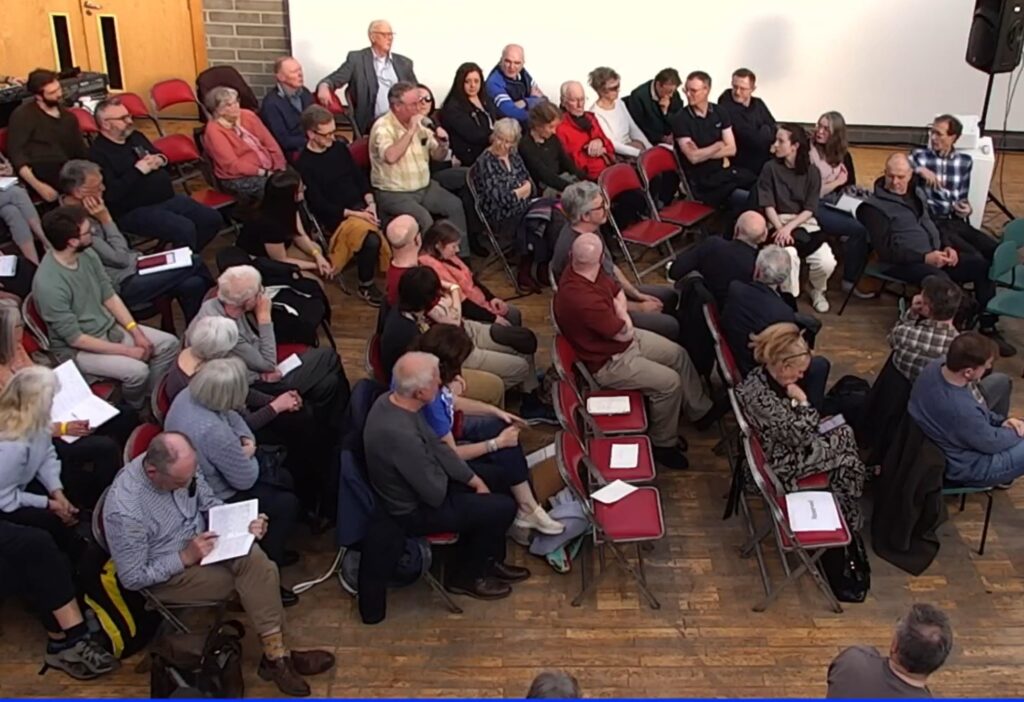
The latest highlight of the Scotonomics discussion has been “Scotland’s Economics Festival” held in Leith near Edinburgh last weekend, which was open to all who had an interest, and fortunately allowed remote attendees. The festival clearly showed how much wider the discussion can be than what we are used to in Wales, and we got to consider the far-reaching implications arising from the fact that our politicians have not taken the bigger picture into account when making strategic decisions.
To give an idea of the breadth of the discussion, we started with an overview of the different traditions, which include the neoliberalism we are accustomed to, and also the Austrian school, Post-Keynesianism, Institutionalism, Environmental Economics, Feminist, and Marxist economics, all of which shed new light, or provide a different lens, with which to look at our problems and possible solutions. The discussion was lively, with a variety of attendees having the opportunity to contribute.
Personally, I was struck by the power of the feminist interpretation of the economy, presented by Emma Holten, which focused on how dependent a capitalist economy is on the unpaid contribution of wives and families to sustain wage-earning participants, and also the lack of recognition of the value derived from the care given to people with health needs for example. I subsequently ordered a copy of her book “Deficit” in order to learn more about this.
Ultimately the discussion always returns to our interpretation of what is valuable, and why we accept the latest price, which is a precise, but unstable and unbalanced number, to represent what is valuable. Are money and people on the same side? When we have basic service failures, and an environmental crisis, we have to return to these topics and challenge the advice we are given in an intelligent way. Is the cost we associate with overcoming poverty an accurate reflection? Have we put an appropriate price on the inequality that exists in our society? Are we giving enough value and support to our democracy?
Wales needs to raise the level of the economic debate, we need to be able to find our own answers to the practical questions of our world, Scotland is doing that to a further extent than we are at the moment, we have a lot to learn from them.